
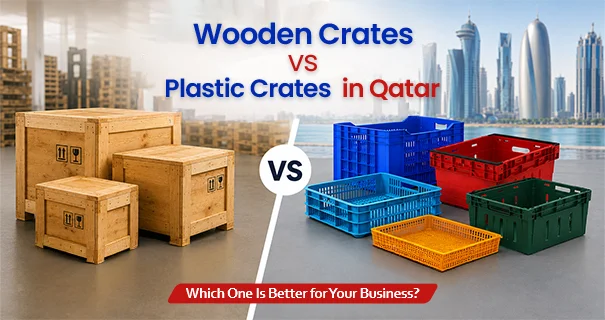
Every warehouse manager, F&B procurement head, and logistics operator in Qatar eventually faces the same question — should we stick with wooden crates or switch to plastic? It’s not just a purchase decision. It’s a call that shapes your storage costs, hygiene compliance, worker safety, and even your export readiness. In this quick guide, LightSpeedTC breaks down the real differences between wooden crates vs plastic crates in Qatar, so you can pick the option that actually fits your business.
Why This Comparison Matters for Businesses in Qatar
Qatar’s operating environment is unique — high humidity, extreme summer heat, strict food safety expectations, and a fast-moving logistics ecosystem tied to Hamad Port and the Free Zones. Storage material choice matters more here than in most markets. Wood behaves one way in a dry European warehouse and another way entirely in a coastal Doha facility. Plastic behaves consistently across both. Understanding this local reality is where most crate-buying decisions should start.
Wooden Crates — Strengths and Limitations
Where Wooden Crates Still Work
Wooden crates have earned their place in industry for a reason. They’re generally lower in upfront cost, easy to repair on-site, and reasonable for one-way export shipments where they won’t be reused. For heavy machinery or industrial parts that don’t touch food or need repeated washing, wood can still be a practical option.
The Real Challenges in Qatar’s Climate
The issues start with Qatar’s heat and humidity. Wood absorbs moisture, which leads to warping, cracking, and eventually splintering. Splinters aren’t just a comfort issue — they’re a workplace safety hazard. Wood also harbours bacteria, moulds, and pests, which is exactly why food, dairy, seafood, and pharma industries have largely moved away from it. On top of that, wooden crates are heavier per unit, which increases handling costs, and they’re harder to sanitize between uses. Over a full year of operation, “cheap” wooden crates often end up costing more than plastic once you factor in replacement, cleaning, and disposal.
Plastic Crates — Why They’ve Become the Modern Standard
Plastic crates have quietly become the default choice across Qatar’s warehouses, food industry, and logistics operations. Made from HDPE or polypropylene, they’re engineered specifically for the demands of modern supply chains.
Key Advantages for Qatar Businesses
- Moisture, heat, and pest resistant — perfect for Qatar’s climate and coastal humidity
- Hygienic and easy to sanitize — meets food, dairy, seafood, and pharma standards
- Stackable and nestable — reclaims warehouse floor space and cuts empty-return costs
- Long service life — years of reuse without warping, cracking, or splintering
- Lightweight — lower handling costs and reduced worker strain
- Consistent dimensions — smoother automation, forklift handling, and racking
LightSpeedTC’s Plastic Crate Range
LightSpeedTC stocks a full range of plastic crates purpose-built for Qatar’s businesses — from bakery crates and ventilated crates for food and produce, to nestable crates and crates with bail arm for logistics operations, plus specialty ranges including fish crates, fruit crates, dates crates, milk crates, and chick baskets. Every product is made from HDPE or PP for long-term durability. Browse the full catalogue on our Plastic Crates page.
Wooden Crates vs Plastic Crates in Qatar — Side-by-Side Comparison
| Factor | Wooden Crates | Plastic Crates (LightSpeedTC) |
| Upfront cost | Lower | Slightly higher |
| Lifespan | 1–2 years typical | 5–10 years with reuse |
| Hygiene | Absorbs moisture, harbours bacteria | Non-absorbent, easy to sanitize |
| Qatar climate resistance | Warps and cracks in humidity | Unaffected by heat and humidity |
| Weight | Heavier | Lightweight |
| Stackability | Inconsistent | Uniform, stackable, nestable |
| Food safety compliance | Limited | Suitable for food, dairy, pharma |
| Long-term cost | Higher (replacement + cleaning) | Lower total cost of ownership |
| Worker safety | Splinter and nail risks | Smooth, safe handling |
When you look at the full picture — not just the sticker price — plastic crates deliver a clearly better return on investment for most Qatar businesses.
Which One Is Better for Your Business?
Choose Wooden Crates If…
- You need a one-way export shipping solution and won’t reuse the crate
- You’re shipping heavy industrial machinery or parts with no hygiene requirements
- Your operation is short-term and initial cost is the only priority
Choose Plastic Crates If…
- You handle food, dairy, seafood, produce, dates, or pharmaceuticals
- Your crates cycle through repeated storage, shipping, and cleaning
- You need long-term durability in Qatar’s heat and humidity
- You want lower total cost of ownership over 3–5 years
- Worker safety, hygiene compliance, and warehouse efficiency matter to your operation
For the vast majority of businesses in Qatar — from bakeries in Doha and seafood distributors near Hamad Port to logistics operators in Ras Bufontas — plastic crates are the smarter long-term choice.
Where to Buy Plastic Crates in Qatar — Why Choose LightSpeedTC
LightSpeedTC has been supplying Qatar’s business community since 1999 (through our sister concern M/s. Gulf Neon) — over 25 years of understanding local procurement standards and delivery expectations. When you source your plastic crates from us, you get:
- A full range under one roof — bakery, fish, fruit, dates, ventilated, nestable, and bail arm crates
- HDPE and PP options matched to your specific application
- Bulk and wholesale pricing for warehouses, food industries, and logistics operators
- Delivery across Qatar — Doha, Lusail, Al Wakrah, Mesaieed, and beyond
- Consultative support — our team helps you match the right crate to the right operation
Final Thoughts
The wooden crates vs plastic crates in Qatar debate really comes down to how your business actually operates. If you’re moving goods once, wood may still work. But if your crates need to survive Qatar’s climate, meet hygiene standards, and deliver years of consistent performance — plastic wins by a clear margin. And when it comes to sourcing plastic crates in Qatar, LightSpeedTC gives you the range, expertise, and local support to make the switch simple.
Frequently Asked Questions (FAQs)
- Are plastic crates better than wooden crates in Qatar’s climate?
Yes. Qatar’s heat and humidity cause wooden crates to warp, crack, and harbour moisture over time. Plastic crates from LightSpeedTC are made from HDPE or PP and are unaffected by heat or humidity, making them the more reliable long-term choice. - Are plastic crates more expensive than wooden crates?
Plastic crates have a slightly higher upfront cost, but they last 5–10 years with reuse compared to 1–2 years for wooden crates. Once you factor in replacements, cleaning, and disposal, plastic crates deliver a significantly lower total cost of ownership. - Which industries in Qatar should switch from wooden to plastic crates?
Food distribution, bakeries, seafood, dairy, fruit and vegetable wholesalers, dates packing, pharmaceuticals, and logistics operators all benefit most from switching to plastic crates because of hygiene, reusability, and climate resistance. - Where can I buy plastic crates in Qatar?
LightSpeedTC supplies plastic crates across Qatar from its office at World Wide Business Centre, Al-Hilal, Doha. Orders can be placed via the website, WhatsApp, phone, or in person, with delivery available Qatar-wide. - What types of plastic crates does LightSpeedTC stock?
LightSpeedTC stocks bakery crates, fish crates, fruit crates, dates crates, milk crates, chick baskets, ventilated crates, nestable crates, and crates with bail arm — all made from HDPE or PP for long service life.



Write a comment
Your email address will not be published. All fields are required