
Search

Spill Pallets Supplier in Qatar

Spill Pallets Supplier in Qatar for Oil & Gas, Chemical & Industrial Sites

Oil, chemicals, lubricants, solvents — every industrial facility in Qatar handles them daily. And every one of these liquids, when spilled, becomes a triple threat: a workplace hazard, an environmental violation, and an expensive cleanup bill. A single unmanaged drum leak can shut down operations for days, trigger regulatory fines, and cause lasting damage to floors, equipment, and worker safety. The most reliable first line of defence? Spill pallets. And the difference between a working spill containment system and a failed one usually comes down to the supplier behind it. In this guide, LightSpeedTC — a trusted spill pallets supplier in Qatar — explains why spill containment matters for oil & gas, chemical, and industrial sites, what to look for in a supplier, and how our range is helping facilities across Qatar stay safe and compliant.

Why Spill Pallets Matter More Here Than in Most Countries

Qatar isn't a gentle operating environment. Summer floor temperatures inside a warehouse can hit numbers that soften cheap plastic and speed up chemical corrosion of drum seams. Add long shifts, quick handling, and forklifts weaving between pallets — and small leaks turn into large problems fast. There's also the regulatory side. Qatari authorities take environmental compliance seriously. A spill that reaches the drain or the sand outside your compound is no longer a mop-and-bucket problem. It's a report, a fine, and often a site shutdown while things get investigated. Spill pallets are what stop that story before it starts. They catch the leak, keep the drum stable, and buy your team the time to fix the issue properly. Which is exactly why every serious industrial buyer we work with — from petrochemical operators to fleet workshops — treats spill containment pallets in Qatar as core infrastructure, not an accessory.

What to Look for in a Spill Pallets Supplier (Before You Order)

Not every supplier who lists spill pallets on a website actually understands them. A quick checklist before you commit:
  • Are the pallets built from proper HDPE, not thin recycled plastic that cracks under UV exposure?
  • Does the supplier give you real sump capacity numbers, or vague "large containment" claims?
  • Can they tell you the static and dynamic load rating for a fully loaded drum or IBC?
  • Do they carry the right range — single drum, four-drum, IBC — or just one option?
  • Can they deliver to Ras Laffan, Dukhan, and Mesaieed, or only inside Doha city limits?
  • Will they hand over a sample first, or expect you to commit to a bulk order blind?
If a supplier stumbles on more than a couple of those, you're not looking at an industrial vendor. You're looking at a retailer who happens to sell pallets.

The LightSpeedTC Spill Pallet Range

Every spill pallet in the LightSpeedTC catalogue is built for one job — surviving Qatar's industrial environment for years, not months. HDPE construction throughout. UV-stabilised for outdoor drum stores. Sump capacities matched to the drums and IBCs you're actually storing.

Drum Spill Pallets

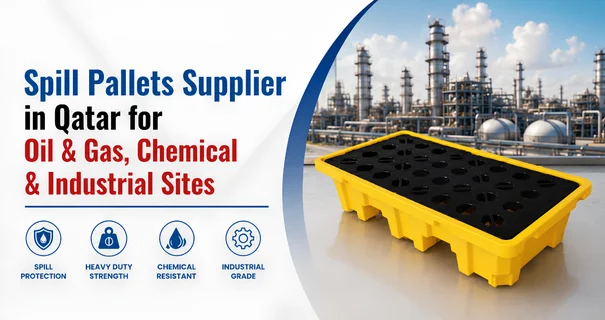
Our standard drum spill pallets are the ones you'll find at the heart of most workshop and warehouse fit-outs across Qatar. A reinforced grate on top keeps the drum clear of any collected liquid. The sump underneath holds the leak until your team can deal with it. Simple, sturdy, and built to take repeated forklift handling without warping.

IBC Spill Pallets

For anyone storing 1,000-litre IBC totes — chemical distributors, oil blenders, larger workshops — the drum-sized pallets aren't enough. Our IBC spill pallets are sized for the bigger footprint and rated for the heavier load, with sump capacities that meet the containment volumes your HSE team is asked about during audits.

Nestable & Stackable Options

Contractors moving spill containment between project sites, or facilities that need seasonal storage, find our nestable and stackable variants especially useful. They tuck away when they're not deployed, freeing up floor space you'd otherwise lose to empty pallets sitting in the corner.

Complementary Products

Because most facility fit-outs need more than just spill pallets, LightSpeedTC also supplies plastic pallets, industrial dustbins, storage containers, and material handling products across the same catalogue. One supplier, one PO, one delivery run. You can browse the full range at www.lightspeedtc.com.

Where Our Spill Pallets Are Being Used Across Qatar

Oil & Gas Sites

From Dukhan to Ras Laffan, oil & gas operators use our spill pallets in drum stores, lubricant sheds, additive rooms, and mobile refuelling stations. HDPE holds up to hydrocarbons without softening, so the pallet is still doing its job three summers later.

Chemical Distributors & Petrochemical Operators

Chemical importers and distributors have some of the tightest storage regulations in the country. Our IBC-format spill pallets are a common request from this segment because they meet the containment volumes required for corrosive and flammable stock.

Manufacturing Plants

Factories across Mesaieed and Ras Bufontas keep our spill pallets on production floors for lubricants, coolants, and process fluids — anywhere a leak could reach a machine, a walkway, or a drain.

Workshops, Garages & Fleet Depots

Every workshop leaks eventually. Engine oil, brake fluid, hydraulic fluid, degreasers — they all end up on the floor if you don't get ahead of it. Our workshop clients tell us they cut cleanup time significantly once spill pallets became standard under every drum.

Third-Party Warehouses & 3PLs

Logistics providers holding client inventory that includes liquids often need spill pallets to accept the contract in the first place. It's become a standard fit-out line item for warehouses handling mixed cargo.

Mistakes Procurement Teams Make (And How to Avoid Them)

We've seen these come up on almost every large enquiry:
  • Sizing the sump too small. A single 200-litre drum needs sump capacity that meets the 110% rule most auditors apply. Skip this and your pallet fails the first inspection.
  • Choosing plastic that isn't UV-stable. If any of your drums live outdoors — even in a shaded compound — Qatar's sun will find weak plastic within a year.
  • Forgetting the load rating. A full IBC weighs over a tonne. That's not a spec you want to guess at.
  • Buying one pallet at a time. Spread the same order across three separate purchases and you'll pay more per unit, get inconsistent stock, and slow down your own project.
  • Skipping the sample. For any order past twenty units, always ask for a sample first. Test it under a real drum, not just visually.
None of these are complicated to avoid. They just need a supplier who talks you through them instead of taking the order and hoping for the best.

Why Facilities Across Qatar Choose LightSpeedTC

We've been supplying Qatar's industrial and commercial sectors since 1999 through our sister concern M/s. Gulf Neon — over 25 years of understanding how procurement actually works here. HSE audits, project timelines, LPO cycles, the whole ecosystem. A few things our clients tell us matter most:
  • We stock the full range, so you don't chase separate suppliers for drums and IBCs
  • Our load and sump specs are the real ones, not marketing rounded numbers
  • Bulk pricing scales properly with volume, and it holds across repeat orders
  • Delivery reaches the industrial zones, not just Doha city
  • Our account managers actually pick up their phones
None of that sounds revolutionary. But if you've been let down by suppliers who ghost you after the first order, it starts to matter a lot.

How to Get Started with LightSpeedTC

Ordering with us is pretty straightforward. Send us a note with what you're storing, how many drums or IBCs are involved, and where you need the pallets delivered. We'll come back with a recommendation, a formal quote, and a sample if you're placing a larger order. Once the sample checks out, we finalise pricing and coordinate delivery on your timeline. Most clients hear back from us the same day.

Final Word

Spill containment is one of those investments nobody notices until it saves them from a very expensive week. Pick the right spill pallets supplier in Qatar and it disappears into the background of your operation. Pick the wrong one and you'll rediscover the value of a good pallet the hard way. LightSpeedTC has been doing this for Qatar's industrial buyers for over two decades. If you're outfitting a new store, upgrading a chemical warehouse, or bringing containment onto a new project site — send us the brief and we'll take it from there.

FAQs

  1. Who supplies spill pallets in Qatar for oil & gas and industrial buyers? LightSpeedTC has been supplying spill pallets and industrial containment to Qatar's oil & gas, chemical, and manufacturing sectors since 1999 — with delivery across Doha, Mesaieed, Ras Laffan, Dukhan, and Ras Bufontas.
  2. Do you handle bulk orders? Yes, most of our spill pallet orders are bulk — anywhere from twenty units for a single warehouse fit-out to several hundred for a project site rollout. Pricing scales with volume, and we can hold pricing for scheduled repeat orders.
  3. What spill pallet sizes do you stock? Standard drum-format spill pallets for one or multiple 200-litre drums, IBC-format spill pallets for 1,000-litre totes, and nestable variants for facilities that move containment between locations.
  4. Are your spill pallets suitable for chemical and hydrocarbon storage? Yes. Everything in our range is made from HDPE, which handles a wide range of oils, solvents, and common industrial chemicals without degrading. If you're storing something specialised, share the chemical name and we'll confirm compatibility before you order.
  5. Can these pallets live outdoors in Qatar's climate? They're built for it. Our HDPE is UV-stabilised so it doesn't turn brittle in the summer sun, which is what happens to cheaper plastic within a season.
Spill Pallets in Qatar

Spill Pallets in Qatar

Reliable Industrial Spill Control with Spill Pallets in Qatar | LightSpeedTC

Spill pallets play a vital role in maintaining safe and compliant industrial environments, especially in rapidly developing regions where large volumes of liquids are handled every day. In Qatar’s expanding industrial, logistics, construction, and energy sectors, safe liquid storage is not just an operational detail but a core requirement for protecting people, property, and the environment. This is where Spill Pallets in Qatar, LightSpeedTC become a critical part of modern facility design, offering dependable secondary containment for drums and containers that hold oils, fuels, chemicals, and other hazardous liquids. A spill pallet is designed as a containment platform with a grated top surface and a sealed sump underneath. Containers sit securely on the grating, and any leaks, drips, or ruptures are automatically captured in the sump instead of spreading across the floor. This simple containment principle prevents small incidents from becoming major hazards. In busy industrial settings, even a minor unnoticed leak can create slippery surfaces, chemical exposure risks, fire hazards, or environmental contamination. By capturing liquids at the source, spill pallets create an immediate barrier between hazardous substances and the surrounding workplace. Qatar’s climate and industrial conditions make robust containment even more important. High temperatures, dust, heavy equipment movement, and continuous operations put stress on storage systems. Quality spill pallets are built to withstand these conditions without warping, cracking, or corroding. Polyethylene models are widely used because they resist a wide range of chemicals and do not rust, while heavy-duty steel options are chosen for extremely high load environments. Choosing the right material ensures long service life and reliable performance even in harsh outdoor yards or demanding warehouse floors. The growing focus on environmental responsibility has made secondary containment a standard expectation rather than an optional extra. Liquid spills that reach soil or drainage systems can lead to long-term contamination and extremely costly remediation work. Preventing that damage is far more practical and economical than fixing it later. This preventative mindset is exactly why facilities are increasingly adopting Spill pallets in Qatar, LightSpeedTC as a baseline safety measure wherever hazardous liquids are stored or handled. Industrial accidents are rarely caused by dramatic catastrophic failures. More often, they begin with small, repeated leaks that go unnoticed until they accumulate into a serious problem. A slow drip from a valve or a hairline crack in a drum can spread thin layers of liquid across smooth floors, creating invisible slip hazards. In areas where flammable liquids are present, vapour build-up from uncontrolled spills can increase ignition risk. Containment pallets stop this chain reaction at the very first stage by keeping every drop inside a controlled reservoir. In oil and gas operations, maintenance yards, and refuelling zones, safe handling of fuels and lubricants is essential. Equipment is frequently moved, hoses are connected and disconnected, and containers are repositioned. Each of these actions carries some spill risk. When drums and containers are placed on properly rated spill pallets, any accidental release remains confined within the sump capacity. This allows teams to respond calmly and safely without shutting down large operational areas. The use of Spill pallets in Qatar, LightSpeedTC in such environments supports uninterrupted work while still meeting strict safety expectations. Warehouses and logistics centres benefit in a similar way. Forklifts and pallet jacks move constantly through storage aisles, and accidental impacts can damage containers. Without containment, a punctured drum could quickly spread liquid across a wide floor area, forcing evacuation and lengthy cleanup. With spill pallets in place, the same incident is limited to a single contained unit that can be isolated and cleaned without disrupting the entire facility. This containment improves both safety and operational continuity. Regulatory compliance is another strong driver for secondary containment. International best practices commonly require that hazardous liquid storage includes containment capable of holding at least the full volume of the largest stored container. Spill pallets are engineered with defined sump capacities to meet this requirement. Using properly specified pallets demonstrates a proactive and auditable approach to safety management. Facilities that implement Spill pallets in Qatar, LightSpeedTC show regulators, clients, and auditors that spill risks are anticipated and controlled rather than ignored. Operational efficiency improves when spills are contained immediately. Cleanup becomes faster and more predictable because the liquid is already confined to a known volume. Workers can remove the damaged container, recover or dispose of the captured liquid, wipe down the unit, and return it to service with minimal downtime. Removable grating surfaces make access to the sump easy, reducing the effort required for maintenance and inspection. Different tasks require different containment formats. Single-drum pallets are ideal for isolated workstations or small storage points. Two-drum and four-drum pallets support centralised chemical storage areas. Low-profile designs make loading easier with drum trolleys, while forkliftable versions allow entire loaded pallets to be repositioned as layouts change. Modular spill decks can be connected to create large custom containment zones for bulk storage. This adaptability allows facilities to design spill control exactly around their workflow rather than forcing operations to fit a fixed shape. Outdoor storage adds further considerations. Strong sunlight and occasional heavy rain can affect containment performance if equipment is not properly specified. UV-stabilised materials resist degradation from long sun exposure, and compatible covers or shelters prevent rainwater from filling the sump and reducing available capacity. Proper outdoor setups ensure that only actual spills are collected and that containment volume is always available when needed. Spill containment is not only for large drums. Smaller pallets and trays support jerry cans, bottles, and compact equipment that may leak during storage or servicing. Mobile spill pallets on wheels can be positioned under pumps, engines, or hydraulic systems during maintenance work to catch drips in real time. This flexibility extends the protection of Spill pallets in Qatar, LightSpeedTC beyond static storage into active operational and repair activities. A contained storage area also improves housekeeping and visual organisation. Clearly defined containment zones make it obvious where hazardous materials belong and discourage unsafe temporary placement on bare floors. A tidy, well-structured storage layout reflects a strong safety culture and makes training new staff simpler because expectations are visually reinforced. Environmental protection is one of the most valuable long-term benefits. Repeated minor spills that reach the ground can slowly contaminate soil and groundwater, leading to major liability and cleanup costs. Secondary containment prevents this hidden accumulation of damage. By stopping liquids before they escape into the environment, spill pallets act as a permanent preventative barrier rather than a reactive fix. Correct specification matters. Pallets must safely support the full weight of loaded containers without flexing. Reinforced structures and anti-slip grating keep drums stable and reduce tipping risk. Chemical compatibility must also be checked so that the pallet material will not degrade when exposed to the stored liquid. Matching the containment system to the substance being handled ensures durability and safe long-term use. Mobility is another practical advantage. Many spill pallets are designed to be lifted by forklift, allowing storage areas to be reconfigured as operational needs change. This makes it easy to expand, relocate, or reorganise containment zones without draining and dismantling fixed structures. Facilities remain flexible while still maintaining full spill protection. Routine inspection keeps the system ready at all times. Staff should check that sumps are empty, gratings are properly seated, and there are no cracks or structural damage. If a spill has been captured, the liquid should be safely removed and disposed of according to local regulations so that full capacity is restored. Simple maintenance ensures that Spill pallets in Qatar, LightSpeedTC continue to provide dependable protection every day. Training completes the safety system. Workers need to know that containers must sit fully on the grating, never on the edges, and that any captured spill must be reported and managed promptly. Clear procedures turn spill pallets from passive equipment into an active, well-understood safeguard embedded in daily operations. As Qatar’s industries continue to grow and modernise, expectations for safety and environmental stewardship will keep rising. Secondary containment is one of the most practical and visible ways to meet those expectations. It protects employees from slips and chemical exposure, protects facilities from costly incidents and downtime, and protects the wider environment from contamination. The real strength of spill pallets is their quiet reliability. Most days they simply sit beneath containers doing nothing noticeable, yet in the moment a leak occurs they prevent escalation instantly. That silent prevention is what keeps operations stable and compliant. By integrating Spill pallets in Qatar,  LightSpeedTC  into storage, transfer, and maintenance areas, organisations build a dependable first line of defence that supports safe, efficient, and responsible industrial activity for years to come. Frequently Asked Questions (FAQs) – Spill Pallets in Qatar, LightSpeedTC
  1. What is a spill pallet and why is it used? A spill pallet is a containment platform designed to hold drums or containers of liquids and capture any leaks or spills in a built-in sump below. It prevents hazardous liquids from spreading across the floor, reducing slip risks, fire hazards, and environmental contamination.
  2. Where are spill pallets commonly used in Qatar? They are widely used in oil and gas sites, warehouses, factories, workshops, chemical storage areas, logistics yards, and maintenance zones where oils, fuels, or chemicals are stored or handled.
  3. How do spill pallets help with safety compliance? They provide secondary containment, which is a common safety and environmental requirement for hazardous liquid storage. By holding leaked liquid inside the sump, they help facilities meet inspection and regulatory expectations.
  4. What materials are spill pallets made from? Most are made from chemical-resistant polyethylene or heavy-duty coated steel. Polyethylene is popular for chemical storage because it does not rust and resists many corrosive substances.
  5. Can spill pallets be used outdoors in Qatar’s climate? Yes. Outdoor-rated spill pallets are UV-stabilised to handle strong sunlight and high temperatures. They are often paired with covers or shelters to keep rainwater from filling the sump.
 
Back to Top
Product has been added to your cart
WhatsApp