
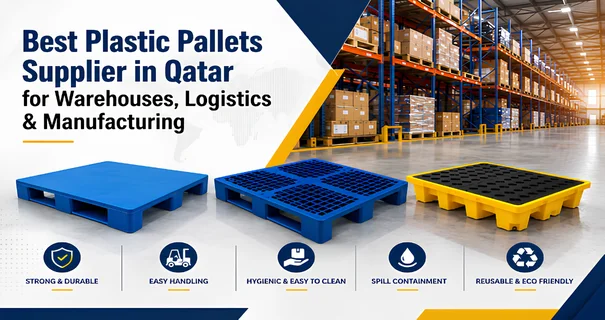
Best Plastic Pallets Supplier in Qatar for Warehouses, Logistics & Manufacturing
Behind every efficient warehouse in Qatar sits a quiet piece of infrastructure most people never think about — the pallet. It carries the load, moves the goods, holds the racking system together, and sets the pace of the entire operation. Choosing the right plastic pallets supplier in Qatar isn't just a procurement task. It's a decision that shapes your warehouse safety, throughput speed, hygiene compliance, and long-term operating cost. In this guide, LightSpeedTC explains what to look for in a supplier, showcases our full plastic pallet range, and shows you why we've become a trusted partner to warehouses, logistics operators, and manufacturers across Qatar.
Why Choosing the Right Plastic Pallets Supplier in Qatar Matters
Qatar's industrial and logistics sector is running at full speed. New warehouses are opening around Ras Bufontas and the Free Zones, Hamad Port continues to expand its cargo throughput, and factories in Mesaieed are scaling up in line with Vision 2030 targets. In this environment, unreliable pallets don't just cause inconvenience — they cause safety incidents, product damage, and expensive downtime. The wrong supplier costs you in ways that don't show up on the initial invoice. Under-spec pallets buckle under racking loads and drop pallets from height. Cheap plastic cracks in Qatar's summer heat and forces early replacement. Inconsistent dimensions jam automated conveyor systems. Late deliveries stop entire warehouse projects. Working with a specialist plastic pallets supplier in Qatar who understands the local operating environment protects your operation from all of these hidden costs — and lets your team focus on running the business, not chasing suppliers.What to Look for in a Plastic Pallets Supplier in Qatar
Not every supplier is built for serious industrial procurement. Before you commit to a partner, make sure they check these boxes:- Full product range — flat, grid, spill, and pallet boxes stocked under one roof so you don't juggle multiple vendors
- Verified load specifications — clearly stated dynamic, static, and racking load ratings you can rely on
- HDPE and PP options — matched to your goods, environment, and hygiene requirements
- Bulk order capacity — able to handle 50-pallet warehouse orders and 5,000-pallet logistics rollouts alike
- Delivery across Qatar — not just Doha, but Lusail, Mesaieed, Al Wakrah, Ras Bufontas, and beyond
- Local expertise — genuine understanding of Qatari procurement standards, business cycles, and compliance
- After-sales support — replacement, replenishment, and ongoing supply arrangements built for repeat buyers
LightSpeedTC's Plastic Pallets Range at a Glance
At LightSpeedTC, our plastic pallet lineup is engineered specifically for Qatar's warehousing, logistics, and manufacturing sectors. Every product is made from HDPE using one-shot molding for consistent structural integrity, with 4-way entry that fits seamlessly into any forklift and pallet-jack workflow.Flat Plastic Pallets (PLG3001)
Our flagship flat pallet is built around the industry-standard 1200 x 1000 x 150 mm footprint. Available in HDPE and PP with weights ranging from 11.5 to 18.5 kg, these pallets deliver dynamic loads of 1000–1500 kg, static loads of 4000–6000 kg, and racking loads of 1000 kg. They're the workhorse choice for food, pharma, cold storage, and general warehousing — anywhere you need a flat, solid surface to distribute weight evenly across your goods.Grid Plastic Pallets
Grid-top pallets are built on the same Three Runner base, but with an open lattice surface that allows air circulation and drainage. This makes them the right choice for food-industry operations where hygiene is critical, cold chain logistics where condensation needs to escape, and any environment where airflow prevents moisture damage. They also weigh less than solid flat pallets, reducing handling strain and shipping weight.Spill Plastic Pallets
Spill pallets are purpose-built with a raised containment tray that catches leaks, drips, and spills from hazardous liquids. They're an essential piece of infrastructure for oil & gas operations, chemical storage sites, workshops handling lubricants and solvents, and any industrial facility where environmental compliance is non-negotiable. Beyond compliance, they protect your workforce from slip hazards and your floors from chemical damage.Plastic Pallet Boxes
For businesses that need pallet-format bulk storage, our range includes Vented Pallet Boxes (PBSF001, 32 kg), Solid Folding Pallet Boxes (45 kg), Vented Folding Pallet Boxes (PBVF001, 43 kg), and the CNVF001 Folding Large Container. All are built on the standard 1200 x 1000 footprint for seamless integration with your existing pallet workflow, and the folding designs collapse when empty to reclaim significant warehouse and return-shipping space. Browse the full range at lightspeedtc.com.Common Mistakes Businesses Make When Buying Plastic Pallets in Qatar
Even experienced procurement teams fall into the same traps when sourcing pallets. Here are the mistakes we see most often — and how to avoid them:- Buying on price alone. Cheap pallets fail early, and the replacement cost quickly exceeds the initial savings. Always calculate cost per year of service, not sticker price.
- Ignoring racking load ratings. A pallet may handle 4000 kg on the floor but only 1000 kg on a racking beam. Match the racking rating to your storage system, not just your product weight.
- Mismatching pallet type to application. Grid pallets in dry warehouses waste airflow benefits. Solid flats in food industry create hygiene problems. Match the type to the actual use.
- Overlooking climate factors. Qatar's summer heat degrades low-grade plastic quickly. Insist on UV-stabilized HDPE for outdoor or semi-open storage.
- Ordering without samples. For any bulk order, always request sample pallets first to verify dimensions, weight, and load performance in your actual workflow.
Why LightSpeedTC Is the Trusted Plastic Pallets Supplier in Qatar
LightSpeedTC has been supplying Qatar's business community since 1999 (through our sister concern M/s. Gulf Neon). That's over 25 years of understanding what Qatari warehouses, factories, and logistics operators actually need — and delivering it consistently. Here's what sets us apart as a bulk plastic pallets Qatar partner:- Industrial-grade range — every product engineered for commercial use, not repurposed household plastic
- Verified load specifications — every pallet clearly rated for dynamic, static, and racking loads
- 25+ years of local expertise — deep understanding of Qatar's procurement standards and delivery expectations
- Bulk and wholesale pricing — competitive rates that scale with order volume
- End-to-end procurement support — dedicated account managers for repeat buyers
- Fast delivery Qatar-wide — Doha, Lusail, Al Wakrah, Al Khor, Mesaieed, Ras Bufontas, and beyond
- Client roster you can trust — leading government institutions, hospitality groups, and industrial operators
Industries We Serve Across Qatar
Our industrial plastic pallets in Qatar are trusted by businesses across every major sector of the economy. Warehousing & Logistics operators — including Hamad Port service providers, freight forwarders, and 3PL companies — rely on our flat and grid pallets for daily cargo movement and racking storage. Manufacturing facilities use our heavy-duty range across production floors, raw material storage, and finished goods dispatch, where consistent load performance directly impacts production uptime. Food & Cold Chain businesses — dairy, seafood, meat, and produce distributors — depend on our HDPE pallets for their hygiene, wash-down capability, and drainage properties. Pharmaceutical operators choose plastic over wood for hygiene-critical storage where wooden splinters, moisture, and pest risks are unacceptable. Beyond these, we regularly supply:- Retail Distribution — supermarket supply chains and back-of-house operations
- Oil & Gas — spill pallets for hazardous material handling and environmental compliance
- Government & Institutional Buyers — bulk supply for defence, ministries, and public sector projects
- Construction & Industrial — durable pallets for site material handling
How to Order Plastic Pallets in Bulk from LightSpeedTC
Getting started as a wholesale buyer is straightforward. Share your requirements with our team — quantity, load class, application, and delivery location — and we'll recommend the right pallet mix, prepare a formal quotation, and coordinate delivery on your schedule. For larger orders, we offer sample pallets so your operations team can verify fit, dimensions, and workflow compatibility before you commit to full volume. Once samples are approved, we issue formal bulk pricing, confirm delivery timelines, and handle logistics end-to-end. For clients on ongoing supply arrangements, we schedule replenishment cycles aligned to your business rhythm — no more emergency pallet shortages during peak season. Most enquiries are answered within the hour on business days.Final Thoughts
The right pallet supplier disappears into your operation — deliveries arrive on time, load ratings match reality, replacements happen without drama, and your warehouse simply runs. That's the standard LightSpeedTC has been holding for over 25 years as a plastic pallets supplier in Qatar. Whether you're outfitting a new distribution centre, upgrading an existing racking system, or scaling your logistics operation to meet growing demand, we're built to handle bulk pallet procurement end-to-end — with the range, expertise, and local support to make your first order the start of a long-term partnershipFrequently Asked Questions (FAQs)
- Who is the best plastic pallets supplier in Qatar for warehouses and logistics? LightSpeedTC is among Qatar's leading specialists in industrial plastic pallets, supplying warehouses, logistics operators, factories, and government institutions across Doha since 1999.
- Do you supply plastic pallets in bulk across Qatar? Yes. LightSpeedTC handles bulk and wholesale plastic pallet orders of every size — from small warehouse orders to nationwide logistics rollouts — with volume pricing and coordinated delivery across Qatar.
- What types of plastic pallets does LightSpeedTC stock? LightSpeedTC stocks flat pallets, grid pallets, spill pallets, and a full range of plastic pallet boxes including vented, solid folding, and vented folding options, all made from HDPE with one-shot molding for structural strength.
- What are the load capacities of LightSpeedTC's plastic pallets? Our PLG3001 flat pallets deliver dynamic loads of 1000–1500 kg, static loads of 4000–6000 kg, and racking loads of 1000 kg. Load ratings vary by pallet type — our team can recommend the right load class for your application.
- Can I get sample pallets before placing a bulk order? Yes. LightSpeedTC provides sample pallets so your operations team can verify dimensions, weight, and workflow compatibility before committing to a bulk order.