
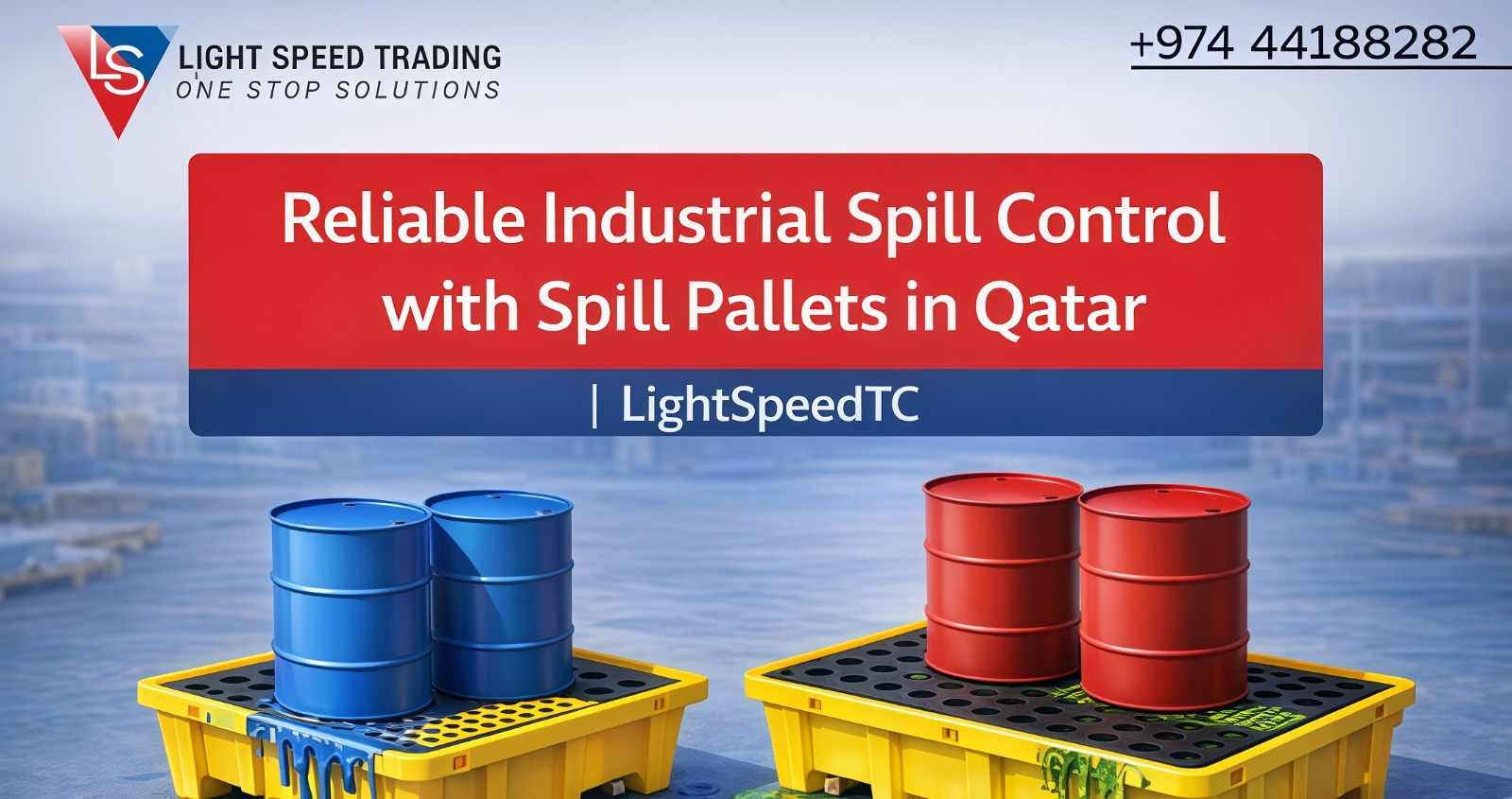
Reliable Industrial Spill Control with Spill Pallets in Qatar | LightSpeedTC
Spill pallets play a vital role in maintaining safe and compliant industrial environments, especially in rapidly developing regions where large volumes of liquids are handled every day. In Qatar’s expanding industrial, logistics, construction, and energy sectors, safe liquid storage is not just an operational detail but a core requirement for protecting people, property, and the environment. This is where Spill Pallets in Qatar, LightSpeedTC become a critical part of modern facility design, offering dependable secondary containment for drums and containers that hold oils, fuels, chemicals, and other hazardous liquids.
A spill pallet is designed as a containment platform with a grated top surface and a sealed sump underneath. Containers sit securely on the grating, and any leaks, drips, or ruptures are automatically captured in the sump instead of spreading across the floor. This simple containment principle prevents small incidents from becoming major hazards. In busy industrial settings, even a minor unnoticed leak can create slippery surfaces, chemical exposure risks, fire hazards, or environmental contamination. By capturing liquids at the source, spill pallets create an immediate barrier between hazardous substances and the surrounding workplace.
Qatar’s climate and industrial conditions make robust containment even more important. High temperatures, dust, heavy equipment movement, and continuous operations put stress on storage systems. Quality spill pallets are built to withstand these conditions without warping, cracking, or corroding. Polyethylene models are widely used because they resist a wide range of chemicals and do not rust, while heavy-duty steel options are chosen for extremely high load environments. Choosing the right material ensures long service life and reliable performance even in harsh outdoor yards or demanding warehouse floors.
The growing focus on environmental responsibility has made secondary containment a standard expectation rather than an optional extra. Liquid spills that reach soil or drainage systems can lead to long-term contamination and extremely costly remediation work. Preventing that damage is far more practical and economical than fixing it later. This preventative mindset is exactly why facilities are increasingly adopting Spill pallets in Qatar, LightSpeedTC as a baseline safety measure wherever hazardous liquids are stored or handled.
Industrial accidents are rarely caused by dramatic catastrophic failures. More often, they begin with small, repeated leaks that go unnoticed until they accumulate into a serious problem. A slow drip from a valve or a hairline crack in a drum can spread thin layers of liquid across smooth floors, creating invisible slip hazards. In areas where flammable liquids are present, vapour build-up from uncontrolled spills can increase ignition risk. Containment pallets stop this chain reaction at the very first stage by keeping every drop inside a controlled reservoir.
In oil and gas operations, maintenance yards, and refuelling zones, safe handling of fuels and lubricants is essential. Equipment is frequently moved, hoses are connected and disconnected, and containers are repositioned. Each of these actions carries some spill risk. When drums and containers are placed on properly rated spill pallets, any accidental release remains confined within the sump capacity. This allows teams to respond calmly and safely without shutting down large operational areas. The use of Spill pallets in Qatar, LightSpeedTC in such environments supports uninterrupted work while still meeting strict safety expectations.
Warehouses and logistics centres benefit in a similar way. Forklifts and pallet jacks move constantly through storage aisles, and accidental impacts can damage containers. Without containment, a punctured drum could quickly spread liquid across a wide floor area, forcing evacuation and lengthy cleanup. With spill pallets in place, the same incident is limited to a single contained unit that can be isolated and cleaned without disrupting the entire facility. This containment improves both safety and operational continuity.
Regulatory compliance is another strong driver for secondary containment. International best practices commonly require that hazardous liquid storage includes containment capable of holding at least the full volume of the largest stored container. Spill pallets are engineered with defined sump capacities to meet this requirement. Using properly specified pallets demonstrates a proactive and auditable approach to safety management. Facilities that implement Spill pallets in Qatar, LightSpeedTC show regulators, clients, and auditors that spill risks are anticipated and controlled rather than ignored.
Operational efficiency improves when spills are contained immediately. Cleanup becomes faster and more predictable because the liquid is already confined to a known volume. Workers can remove the damaged container, recover or dispose of the captured liquid, wipe down the unit, and return it to service with minimal downtime. Removable grating surfaces make access to the sump easy, reducing the effort required for maintenance and inspection.
Different tasks require different containment formats. Single-drum pallets are ideal for isolated workstations or small storage points. Two-drum and four-drum pallets support centralised chemical storage areas. Low-profile designs make loading easier with drum trolleys, while forkliftable versions allow entire loaded pallets to be repositioned as layouts change. Modular spill decks can be connected to create large custom containment zones for bulk storage. This adaptability allows facilities to design spill control exactly around their workflow rather than forcing operations to fit a fixed shape.
Outdoor storage adds further considerations. Strong sunlight and occasional heavy rain can affect containment performance if equipment is not properly specified. UV-stabilised materials resist degradation from long sun exposure, and compatible covers or shelters prevent rainwater from filling the sump and reducing available capacity. Proper outdoor setups ensure that only actual spills are collected and that containment volume is always available when needed.
Spill containment is not only for large drums. Smaller pallets and trays support jerry cans, bottles, and compact equipment that may leak during storage or servicing. Mobile spill pallets on wheels can be positioned under pumps, engines, or hydraulic systems during maintenance work to catch drips in real time. This flexibility extends the protection of Spill pallets in Qatar, LightSpeedTC beyond static storage into active operational and repair activities.
A contained storage area also improves housekeeping and visual organisation. Clearly defined containment zones make it obvious where hazardous materials belong and discourage unsafe temporary placement on bare floors. A tidy, well-structured storage layout reflects a strong safety culture and makes training new staff simpler because expectations are visually reinforced.
Environmental protection is one of the most valuable long-term benefits. Repeated minor spills that reach the ground can slowly contaminate soil and groundwater, leading to major liability and cleanup costs. Secondary containment prevents this hidden accumulation of damage. By stopping liquids before they escape into the environment, spill pallets act as a permanent preventative barrier rather than a reactive fix.
Correct specification matters. Pallets must safely support the full weight of loaded containers without flexing. Reinforced structures and anti-slip grating keep drums stable and reduce tipping risk. Chemical compatibility must also be checked so that the pallet material will not degrade when exposed to the stored liquid. Matching the containment system to the substance being handled ensures durability and safe long-term use.
Mobility is another practical advantage. Many spill pallets are designed to be lifted by forklift, allowing storage areas to be reconfigured as operational needs change. This makes it easy to expand, relocate, or reorganise containment zones without draining and dismantling fixed structures. Facilities remain flexible while still maintaining full spill protection.
Routine inspection keeps the system ready at all times. Staff should check that sumps are empty, gratings are properly seated, and there are no cracks or structural damage. If a spill has been captured, the liquid should be safely removed and disposed of according to local regulations so that full capacity is restored. Simple maintenance ensures that Spill pallets in Qatar, LightSpeedTC continue to provide dependable protection every day.
Training completes the safety system. Workers need to know that containers must sit fully on the grating, never on the edges, and that any captured spill must be reported and managed promptly. Clear procedures turn spill pallets from passive equipment into an active, well-understood safeguard embedded in daily operations.
As Qatar’s industries continue to grow and modernise, expectations for safety and environmental stewardship will keep rising. Secondary containment is one of the most practical and visible ways to meet those expectations. It protects employees from slips and chemical exposure, protects facilities from costly incidents and downtime, and protects the wider environment from contamination.
The real strength of spill pallets is their quiet reliability. Most days they simply sit beneath containers doing nothing noticeable, yet in the moment a leak occurs they prevent escalation instantly. That silent prevention is what keeps operations stable and compliant. By integrating Spill pallets in Qatar, LightSpeedTC into storage, transfer, and maintenance areas, organisations build a dependable first line of defence that supports safe, efficient, and responsible industrial activity for years to come.
Frequently Asked Questions (FAQs) – Spill Pallets in Qatar, LightSpeedTC
- What is a spill pallet and why is it used?
A spill pallet is a containment platform designed to hold drums or containers of liquids and capture any leaks or spills in a built-in sump below. It prevents hazardous liquids from spreading across the floor, reducing slip risks, fire hazards, and environmental contamination. - Where are spill pallets commonly used in Qatar?
They are widely used in oil and gas sites, warehouses, factories, workshops, chemical storage areas, logistics yards, and maintenance zones where oils, fuels, or chemicals are stored or handled. - How do spill pallets help with safety compliance?
They provide secondary containment, which is a common safety and environmental requirement for hazardous liquid storage. By holding leaked liquid inside the sump, they help facilities meet inspection and regulatory expectations. - What materials are spill pallets made from?
Most are made from chemical-resistant polyethylene or heavy-duty coated steel. Polyethylene is popular for chemical storage because it does not rust and resists many corrosive substances. - Can spill pallets be used outdoors in Qatar’s climate?
Yes. Outdoor-rated spill pallets are UV-stabilised to handle strong sunlight and high temperatures. They are often paired with covers or shelters to keep rainwater from filling the sump.


Write a comment
Your email address will not be published. All fields are required